A website that looks like the business you actually run.
Custom design and development for contractors and local service businesses — built mobile-first, written to convert, and structured so search engines and AI systems can read it correctly.
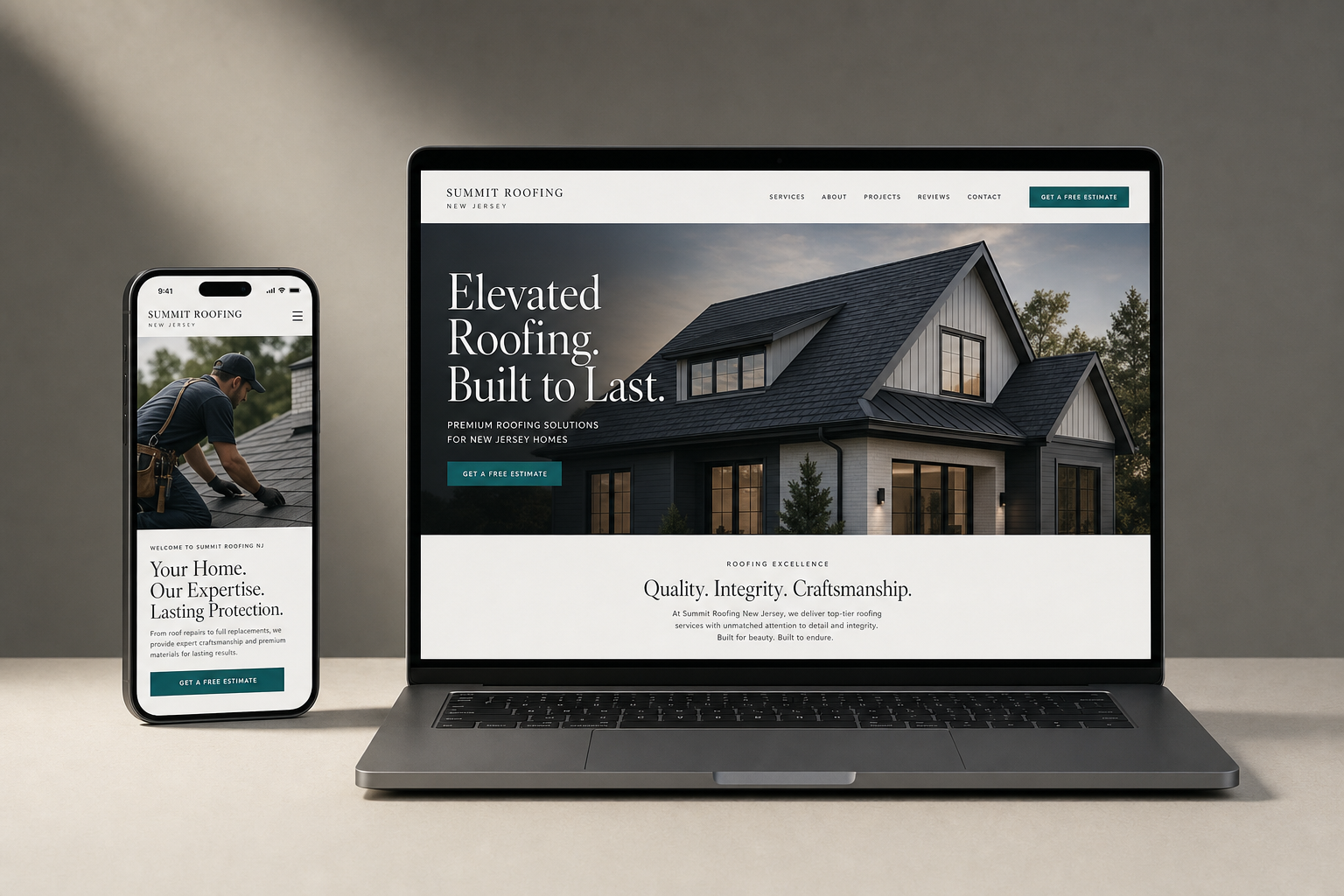 Concept · Summit Roofing NJ
What we build into every site.
Every one of these is standard, not an upsell. What separates a good website from a great one is how they connect to each other — and to the systems running behind the site.
- Original design built for your brand and trade — never a template
- Mobile-first layout, because most of your customers are on a phone
- Copy written to answer real questions, not to fill space
- A dedicated page for every service you offer
- Service-area pages for the cities and neighborhoods you actually cover
- Short contact and quote forms that people actually finish
- Click-to-call buttons that connect a mobile visitor in one tap
- Booking or scheduling integration where it makes sense
- Review integration so your reputation is visible, not buried
- A project gallery for before/after photos and finished work
- CRM connection so form submissions land where you'll see them
- Analytics and Search Console configured correctly from day one
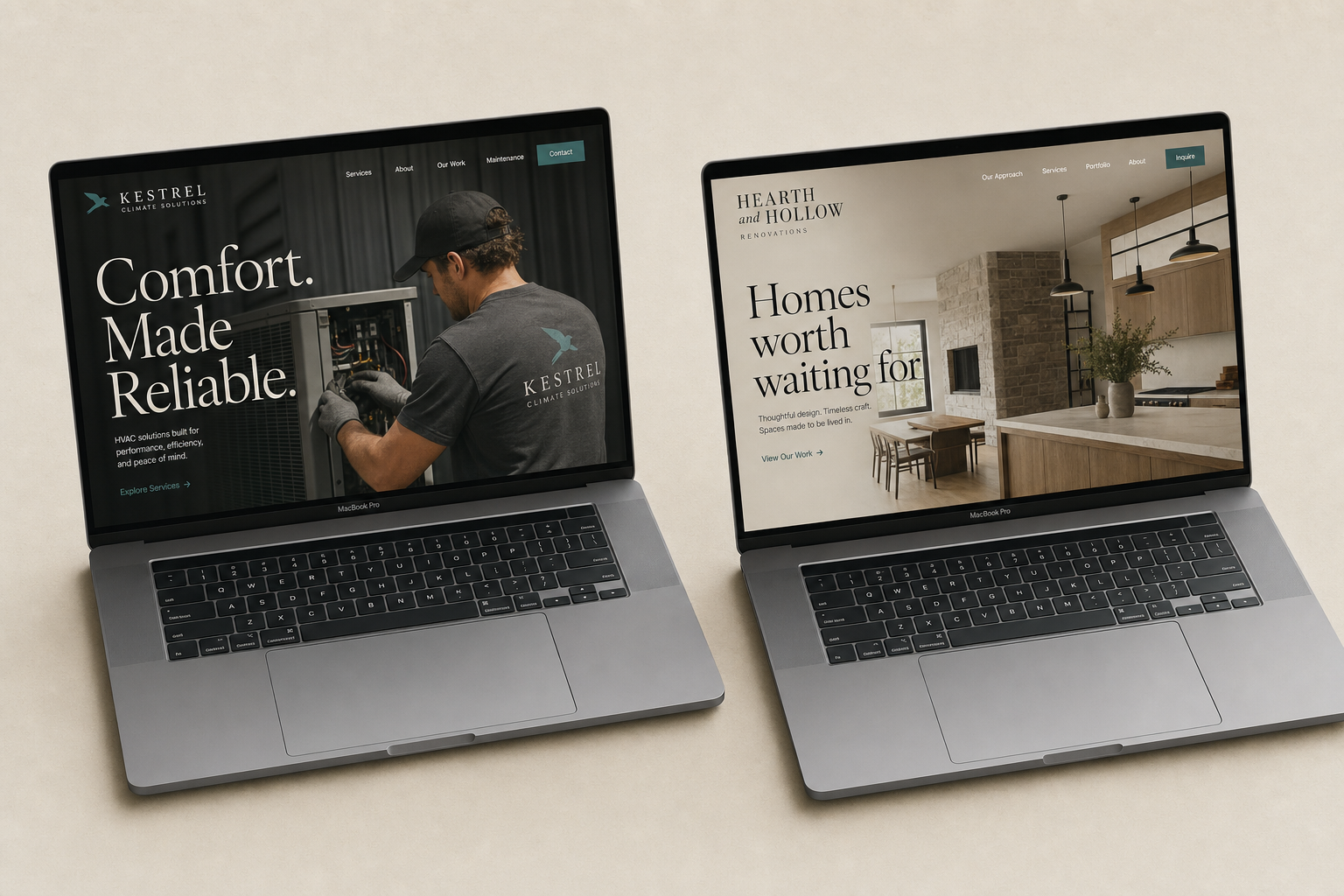
Design that treats the trade with the same craft it treats the work.
Home-service categories usually get generic websites. These two concept builds show what happens when editorial typography, real photography, and a disciplined layout get applied to an HVAC company and a remodeler instead.
Built on a technical foundation search engines and AI systems can actually read.
The visible part of a website is what a customer sees. The invisible part is what Google, Bing, and AI systems read. We build both — and we don't cut corners on the one nobody notices at a glance.
- Fast-loading pages — optimized images, clean code, modern hosting
- Semantic HTML that search engines and AI systems can parse cleanly
- Schema markup that states what the business does, where, and how to reach it
- Accessibility basics — keyboard navigation, contrast, labeled forms
- HTTPS by default, with ongoing security updates and form spam protection
- Core Web Vitals tuned to the metrics Google actually measures
Five phases. Nothing rushed.
A real process, not a sales pitch. Typical timeline runs six to eight weeks from kickoff to launch — faster for simple builds, longer where more systems need to connect.
Discovery
We audit your current site, your competitors, your search visibility, and the way your ideal customer actually decides. You get a written plan before we design anything.
Design
We design the homepage and key page templates first. You see exactly what you're getting before a single line of the site gets built.
Copy & build
We write the copy, structure the pages, build the site, and wire in the tools it needs — forms, booking, review integration, CRM.
Launch
We migrate the site, verify Search Console, install analytics, test every form, and configure the DNS. Nothing goes live untested.
Improve
After launch, we watch what's happening and keep tightening it. On a managed plan, this is ongoing. Otherwise, we're glad to revisit after 30, 60, or 90 days.
What does a new website cost?
We don't publish package pricing, because your business isn't a package. A single-page site for a solo operator costs meaningfully less than a multi-location contractor site with service-area pages and CRM integration. Here's the general shape of it.
Foundation Websites
For smaller businesses that need a credible, professional site with the essential pages covered well. A lower one-time investment.
Local Growth Websites
For businesses that want strong local SEO foundations, service-area pages, and lead capture built in from the start. A mid-range one-time investment, often paired with a monthly managed plan.
Digital Growth Systems
For businesses that want the website, SEO, and lead systems run as one integrated system. Custom scope, ongoing partnership.
The fastest way to get a real number is a free assessment. We'll tell you what your business actually needs and roughly what it would cost — no packages picked at random.
Get a Growth AssessmentQuestions we hear before every website project.
How long does a new website take to launch?
Most projects run six to eight weeks from kickoff to launch, depending on the number of pages, the amount of content we're writing together, and how many systems need to connect. Simpler builds move faster. We'll give you a real timeline after the discovery call, not a guess.
What platform do you build on?
We choose the platform based on the business, not the other way around. That might mean WordPress, Webflow, or custom code. What stays constant is the design quality, the technical foundation, and the fact that you own what we build.
Can I update the website myself after it launches?
Yes. We build sites that a non-technical owner can update — new photos, new service pages, new pricing. If you'd rather not touch it, our managed plans include ongoing updates.
Do I own the website and the domain?
Yes, in full. The domain, the design files, the content, and the code are yours. There's no lock-in and no dependency on us to keep the site running.
Will the new site actually help with Google or AI visibility?
We build every site on a technical foundation that gives it a real chance — semantic HTML, schema markup, fast load times, and a content structure search engines and AI systems can parse correctly. We do not guarantee rankings or AI citations. Nobody honestly can.
Do you handle hosting after launch?
We can, as part of a managed plan, or you can host wherever you prefer. Either way we set things up correctly and hand over clear documentation.
Local SEO and AI search visibility so your new site actually gets found.
Review generation and lead follow-up systems that turn traffic into customers.
Automations that capture and follow up on every lead your site generates.